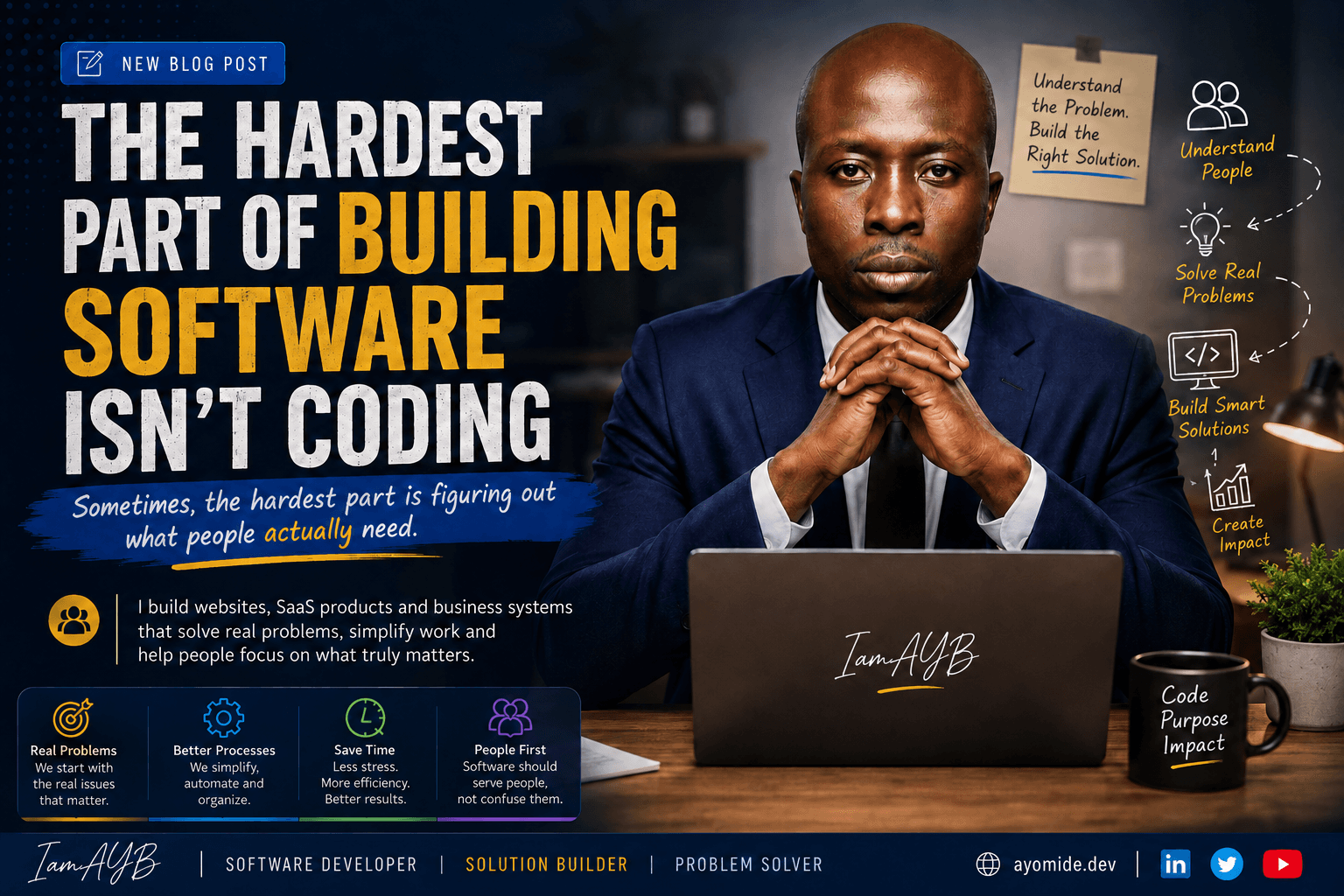
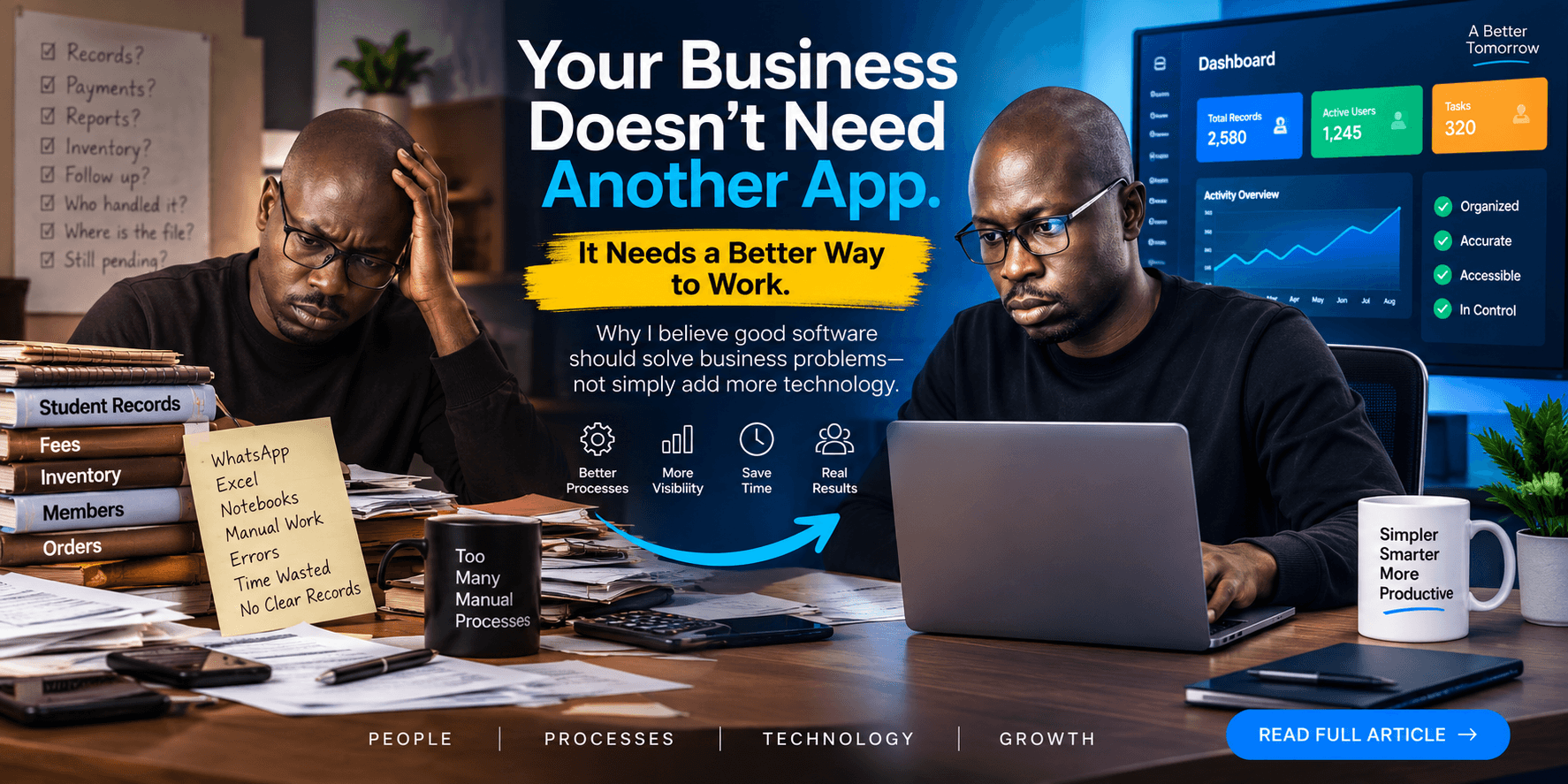
At Some Point, WhatsApp and Excel Stop Being Enough

Let me start with something I think many of us can relate to.
Nigerians are very good at making things work.
Give us a WhatsApp group, an Excel sheet, a notebook and one person who knows what is going on, and somehow, we will run the business.
😂
I've seen businesses use WhatsApp to manage customers.
I've seen people use Excel to keep track of payments.
I've seen important records written in notebooks.
I've seen people keep business information on their personal phones.
And the funny thing is...
It works.
At least, it works in the beginning.
Until the Business Starts Growing
When you have ten customers, you probably know them by name.
You know who has paid.
You know who is owing.
You know what you have in stock.
You know what happened yesterday.
If someone asks you a question, you probably already know the answer.
So why would you need an expensive software system?
You don't.
Not yet.
But then the business starts growing.
Ten customers become fifty.
Fifty become two hundred.
You employ somebody.
Then another person joins.
Transactions increase.
Information increases.
And suddenly, you find yourself asking:
“Where did I keep that information?”
That's usually when the problem begins.
“Check WhatsApp”
This one is very common.
Someone asks:
“Please, who has the list of people that have paid?”
And someone replies:
“I sent it on WhatsApp.”
Okay.
Where?
😂
You start scrolling.
Maybe it was sent in the main group.
Maybe it was the admin group.
Maybe it was a private message.
Maybe somebody sent an updated version yesterday.
Now you're spending 20 minutes looking for something that should have taken 20 seconds to find.
I've seen this kind of thing happen, and honestly, it's not because people are careless.
The system simply wasn't designed for the amount of information they are now handling.
WhatsApp Is Great. But It Is Still WhatsApp.
I use WhatsApp.
You probably use WhatsApp.
Almost everybody uses WhatsApp.
It's fantastic for communication.
But imagine trying to run an entire business from your WhatsApp messages.
Customer records are there.
Payment confirmations are there.
Important decisions are there.
Documents are there.
Orders are there.
Then one day someone asks:
“What exactly did we agree on three months ago?”
Good luck finding it.
😂
That's when you realize something:
WhatsApp is a communication tool.
It wasn't designed to be your company's database.
And Then There Is Excel
I have nothing against Excel.
Actually, Excel is one of the most useful tools ever created for business.
I've used it.
I still use spreadsheets when they make sense.
The problem isn't Excel.
The problem is when we start forcing Excel to become an entire business management system.
One person has one copy.
Another person has another copy.
Someone changes something.
Someone forgets to update theirs.
Then you hear:
“This isn't the latest version.”
And now we have another problem.
Which one is the latest?
😂
Sometimes You Don't Need Software
This is something I want to emphasize because I'm a software developer.
Not every business needs a custom application.
Seriously.
If Excel is working for you, keep using it.
If WhatsApp is enough for a particular part of your business, use it.
If an existing software already solves your problem, there's no reason to pay someone to build another one.
I'm not interested in putting software into a business just because software sounds modern.
The question should always be:
What problem are we trying to solve?
But Sometimes... You Have Outgrown the Old Way
This is where things get interesting.
Maybe you now have 300 customers.
Maybe you have 500 cooperative members.
Maybe your school has 1,000 students.
Maybe your factory is producing different products every day.
Maybe you have several employees accessing the same information.
Maybe you are spending hours preparing reports.
Maybe customers are constantly calling because nobody can quickly give them the information they need.
At this point, the question changes.
It's no longer:
“Can we continue using Excel?”
It's:
“How much is continuing to use Excel costing us?”
That's a completely different question.
The Cost Isn't Always Money
This is something I think business owners sometimes overlook.
The cost of a poor process isn't always obvious.
It can be time.
It can be mistakes.
It can be lost customers.
It can be frustration.
It can be opportunities that you miss because you don't have the right information at the right time.
Imagine spending three hours preparing a report that a proper system could generate in thirty seconds.
You may say:
“It's just three hours.”
But if you're doing that every week...
That's twelve hours every month.
And almost six full days every year.
Just preparing one report.
That's not a small problem anymore.
This Is What Interests Me About Software
This is why, when I'm building a system, I don't want to start by asking:
“What features should we put inside?”
I want to know:
“What is making this person's work difficult?”
That's a better starting point.
Maybe the business owner can't see what is happening.
Maybe the administrator is entering the same information repeatedly.
Maybe the accountant spends too much time reconciling records.
Maybe the manager has to call three people before getting a simple answer.
Maybe customers have to keep asking questions that the system should be able to answer.
Those are the things I want to solve.
Think About SmartFactory
One of the reasons I started working on the idea of SmartFactory is exactly this.
A factory can have a lot going on at the same time.
Materials coming in.
Production happening.
Products going out.
Stock changing.
Orders coming in.
Employees working.
Management asking questions.
Now imagine all of that being managed through different notebooks and spreadsheets.
It might work for a while.
But eventually, somebody will ask:
“How much material do we have left?”
And the answer shouldn't require somebody to start calling three people.
The information should be there.
That's what good software should do.
Make the important information easier to find.
I've Seen the Same Thing With Schools
A school is another good example.
Imagine a school with hundreds of students.
You have student information.
Results.
Payments.
Teachers.
Parents.
Attendance.
Hostel.
Transportation.
Different departments.
If all of this information is sitting in different places, somebody eventually becomes the person who “knows everything.”
And that person becomes very important.
Maybe too important.
Because if that person is unavailable, suddenly nobody knows where anything is.
That's not a good system.
Information should belong to the organization, not to one person's phone.
The Same Thing Happens in Cooperatives and Communities
Take a cooperative with hundreds of members.
At the beginning, maybe the treasurer knows everybody.
But as membership grows, things become harder.
Who has contributed?
Who has taken a loan?
Who is owing?
Who has repaid?
What is the total balance?
What happened last month?
You shouldn't have to open five notebooks to answer those questions.
And you shouldn't have to ask one person:
“Please help me check.”
The information should be available to the people who are authorized to see it.
That's where a properly designed system can make a real difference.
But There Is Something Else I've Learned
And this takes me back to my previous article.
Don't rush to build software.
I've said it before and I'll keep saying it.
A bad process doesn't become a good process simply because you put it inside an application.
If your business process is confusing today, you can build the most beautiful application in the world and still have a confusing business.
So first:
Understand the problem.
Then simplify the process.
Then decide what needs to be automated.
Then build.
That order matters.
Sometimes the Solution Is Surprisingly Simple
Not every solution has to be some huge platform with 50 modules.
Maybe all you need is a proper customer database.
Maybe it's an inventory system.
Maybe it's an online payment and records system.
Maybe it's a portal for your members.
Maybe it's automatic reports.
Maybe it's a simple dashboard that finally gives management visibility.
Sometimes solving one painful problem can make a bigger difference than building 100 features.
I've learned to appreciate that.
I Also Think About Security Differently Now
Once you start putting important business information into a system, another question comes up:
Who should be able to see it?
That's important.
A staff member shouldn't necessarily see everything the owner sees.
A teacher shouldn't necessarily see every administrative record.
One cooperative member shouldn't be able to open another member's financial information.
Someone who can enter information may not need permission to delete it.
These things matter.
So when I talk about building software, I'm not only thinking about how beautiful the interface will be.
I'm also thinking about:
Who can access what?
What happens if someone makes a mistake?
Can we track important activities?
Can the information be recovered?
How do we protect it?
Because when your business information becomes digital, protecting it becomes part of the job.
I Don't Want Technology to Give You More Work
This is probably one of the biggest things I care about.
I've seen software that is supposed to make life easier but somehow creates more work.
You need three people to operate it.
Nobody understands the dashboard.
You have to click through seven pages to do one simple thing.
That's not what I want to build.
If software is supposed to make your work easier, it should actually feel easier.
It doesn't have to be complicated just because the technology behind it is complicated.
Your Business Doesn't Have to Become “Big Tech”
And please don't think I'm saying every Nigerian business needs some massive digital transformation project.
No.
You don't need to become Amazon.
You don't need a team of 50 developers.
You don't even necessarily need a custom application.
What you need is a system that matches where your business is right now and can grow with you.
That's it.
Maybe This Is Where You Are Right Now
Maybe you're reading this and thinking:
“This is exactly what is happening in my business.”
You started small.
The old methods worked.
But now you're spending too much time looking for information.
Your staff keep asking the same questions.
Your records are scattered.
Your reports take too long.
Your customers are waiting for answers.
And you're beginning to feel like you're spending more time managing the business than actually growing it.
If that's you, maybe it's time to look at your process again.
Not necessarily to buy software tomorrow.
Just start by asking:
“Is there a better way to do this?”
That's a good question.
Because That's What Technology Should Be
I don't think technology should make businesses look sophisticated.
I think it should make them work better.
If a system saves someone five hours every week, that's valuable.
If it prevents mistakes, that's valuable.
If it gives an owner information they couldn't easily see before, that's valuable.
If it allows an employee to finish their work and go home on time, that's valuable too.
Sometimes we focus so much on the technology that we forget the person using it.
That's the person I'm thinking about.
One Last Thing
Maybe your business hasn't outgrown WhatsApp.
Maybe Excel is still working perfectly.
Maybe your notebook is still doing the job.
That's fine.
There is no prize for becoming “digital” before you're ready.
But if your current way of working is becoming stressful...
If you're constantly searching for information...
If mistakes are becoming common...
If your business is growing faster than your processes...
Then don't ignore it.
Because eventually, you may reach that point where you realize:
**The business has grown.
But the system hasn't.**
And that's usually when it's time to build something better.
What Problem Are You Trying to Solve?
If you've been thinking about building a website, SaaS product, business management system or internal tool, you don't have to come to me with everything figured out.
You don't even need to know what technology you need.
Just tell me what is frustrating you.
Tell me what takes too much time.
Tell me what keeps going wrong.
Tell me what you're still doing manually.
We can start there.
The technology can come later.