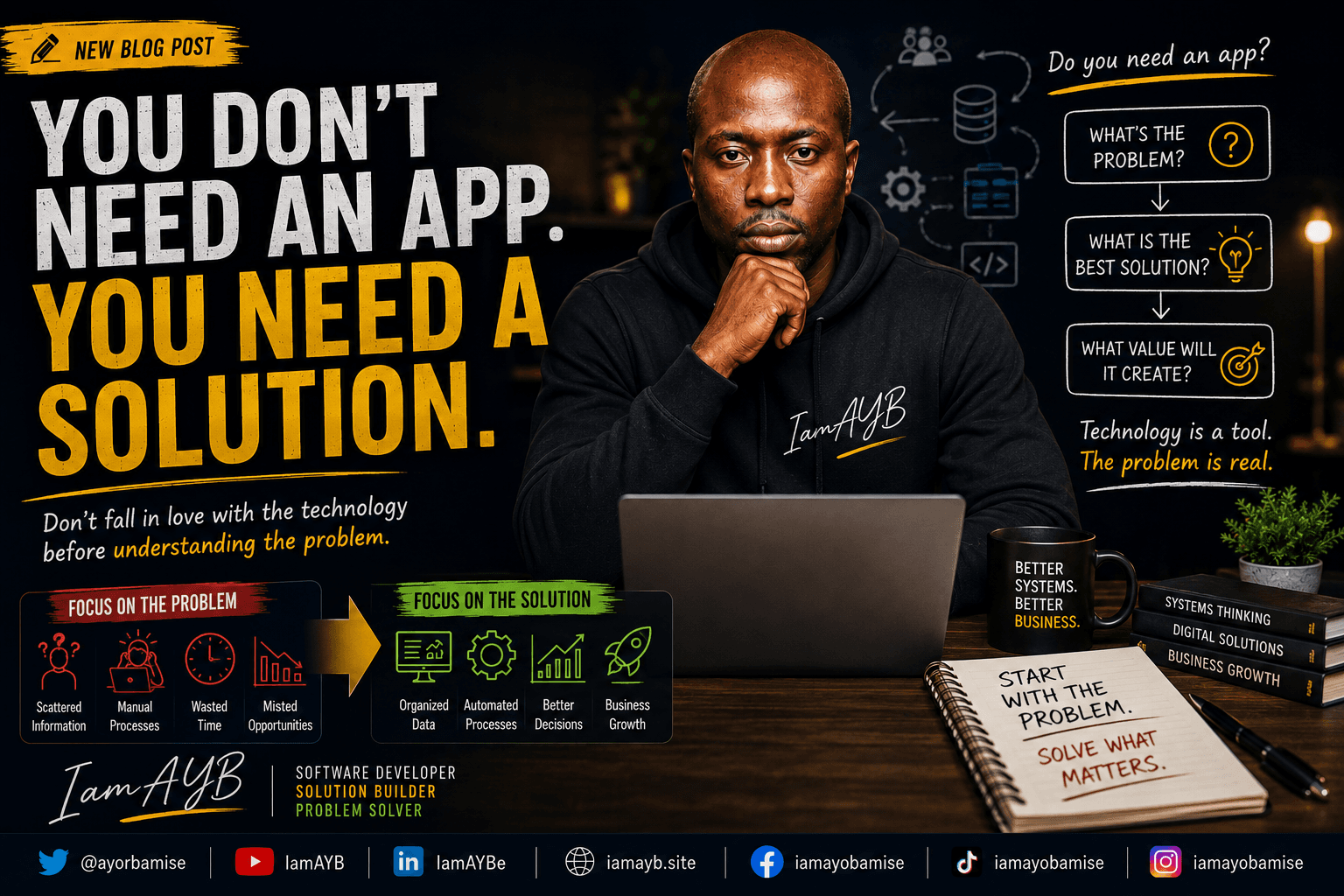
You Don't Need an App. You Need a Solution.
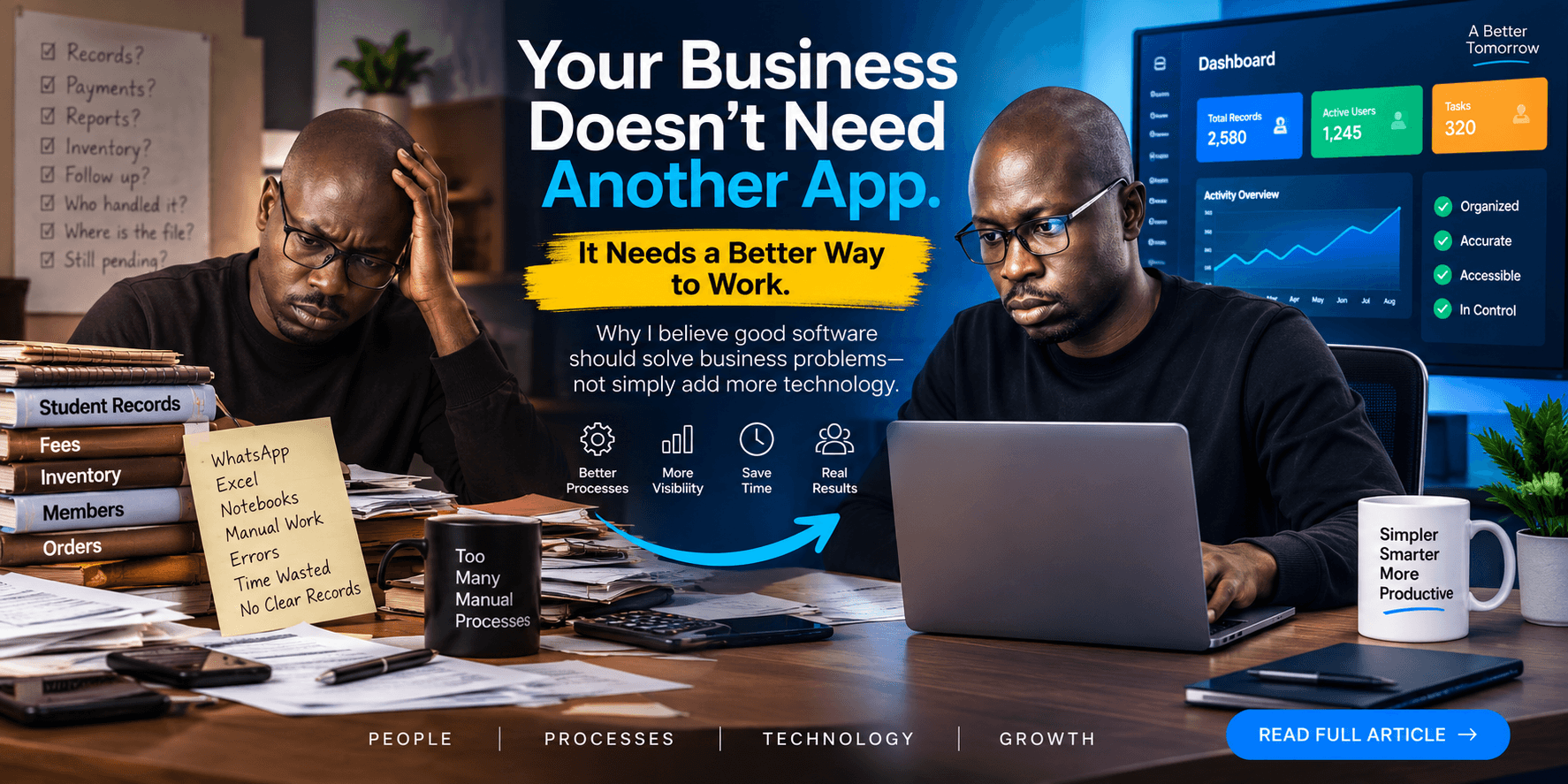
Sometimes, the best solution doesn't look anything like the app you imagined.
There is something I've noticed whenever people talk about technology.
The conversation usually starts with:
“I need an app.”
Not:
“I have a problem.”
Not:
“My customers are struggling with this.”
Not:
“My staff spend six hours every week doing this manually.”
It starts with:
“I need an app.”
And I understand why.
We live in a time where everything seems to have an app.
There's an app for ordering food.
An app for banking.
An app for transportation.
An app for learning.
An app for shopping.
An app for almost everything.
So when a business owner has a problem, the natural thought is:
“Maybe I need an app too.”
But here's something I've learned from building digital products:
You don't really need an app. You need a solution to a problem.
And those two things are not always the same.
Let Me Explain What I Mean
Let's say you run a school.
Your teachers are struggling to record students' results.
Your accountant is using different Excel files.
Parents keep calling to ask about fees.
The administrator has students' information in notebooks.
And the proprietress has to ask three different people before getting a simple report.
You might say:
“We need a school management app.”
Maybe.
But that's not actually the problem.
The problem is:
Your information is scattered.
Your processes are manual.
People don't have access to the information they need.
And too much work depends on individual people.
Now we're getting somewhere.
The software is simply one possible answer.
This Is Why I Asked Those 7 Questions
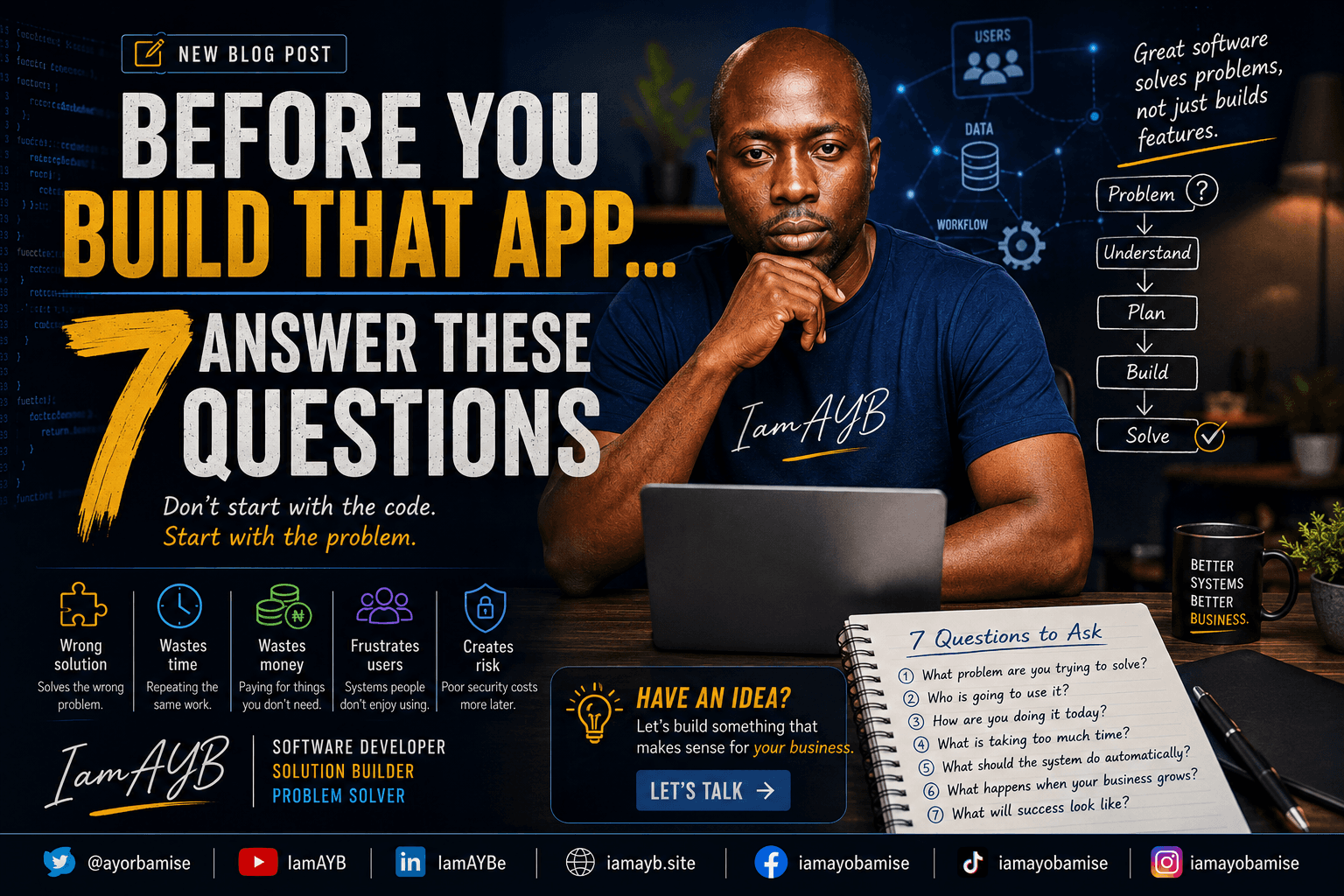
In my previous article, Before You Build That App, Answer These 7 Questions, I talked about something I strongly believe in:
Don't start with the code. Start with the problem.
I meant that.
Before we decide whether you're building a website, mobile app, SaaS platform or internal business system, we need to understand what is actually happening.
Because sometimes the answer surprises you.
You may think you need a mobile app.
After talking through the problem, we discover that a web application is better.
Someone may think they need an expensive custom platform.
We discover that a simpler solution can handle the first stage.
Another person may need a complete SaaS product.
And that's when custom software makes sense.
The point is:
Technology should fit the problem.
Not the other way around.
Don't Build Something Just Because It Looks Cool
I've seen beautiful applications.
Amazing animations.
Beautiful dashboards.
Smooth transitions.
Dark mode.
AI features.
Charts everywhere.
Everything looks impressive.
But then you ask:
“What exactly does this application solve?”
And suddenly...
Silence.
😂
That's the part that worries me.
Because you can build something that looks like a million-naira product and still have something nobody actually needs.
A beautiful solution to the wrong problem is still the wrong solution.
Your Customer Doesn't Care About Your Technology
This one may sound harsh, but it's true.
Your customer probably doesn't care whether you built your application with:
React.
Next.js.
Laravel.
Node.js.
Supabase.
Firebase.
Or whatever technology is trending this month.
They care about something much simpler.
Does it work?
Can I register?
Can I make payment?
Can I find what I need?
Can I track my order?
Can I get my result?
Can I see my contribution?
Can I communicate with you?
Can I get my report?
Can I finish what I came to do without getting confused?
That's what matters.
Think About Your Own Business
Let's bring this home.
Imagine you run a small business.
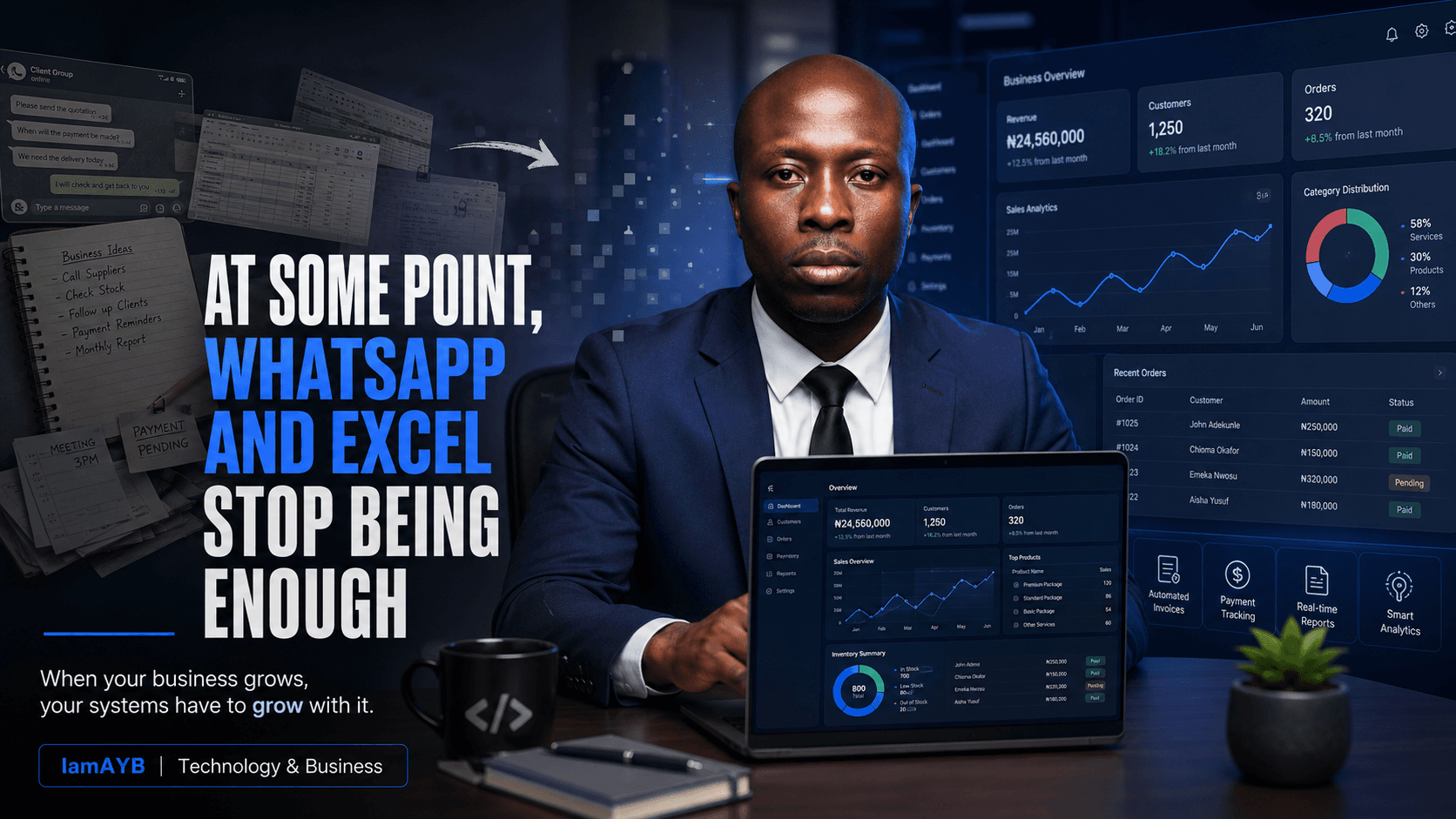
Every morning, your staff open WhatsApp.
Then Excel.
Then a notebook.
Then another WhatsApp group.
Then they call somebody to confirm something.
Then somebody sends a picture of a receipt.
Then somebody enters the same information into another spreadsheet.
At the end of the day, management asks:
“How much did we make today?”
And somebody says:
“Let me check.”
😂
That is not necessarily a people problem.
You may simply have a systems problem.
And that's where technology can help.
Sometimes WhatsApp Is Enough
Yes.
I said it.
Sometimes WhatsApp is enough.
If you're just starting a small business and you have 20 customers, you may not need a custom customer management platform.
Use WhatsApp.
Use your spreadsheet.
Keep things simple.
Don't spend money building software simply because someone told you that serious businesses need software.
Grow first.
Learn what your customers need.
Understand your process.
Then introduce technology where it actually creates value.
But There Comes a Time When Things Change
Eventually, the business grows.
You now have:
200 customers.
500 customers.
2,000 customers.
Five employees.
Ten employees.
Multiple locations.
More transactions.
More information.
More responsibilities.
And suddenly, the things that worked when you were small start becoming painful.
You search through WhatsApp messages.
You can't remember which spreadsheet is the latest.
Someone accidentally deletes a record.
Two people have different versions of the same information.
Customers keep asking questions your staff should be able to answer instantly.
And you begin saying:
“We need something better.”
That's usually the right time to start thinking seriously about software.
Software Should Remove Friction
This is probably one of the simplest ways I can explain what good software does.
It removes unnecessary friction.
If your staff enter the same information five times, remove the repetition.
If customers have to call you for information they should be able to see themselves, give them access.
If management waits three days for a report, automate the reporting.
If employees are making mistakes because information is scattered everywhere, bring the information together.
If you're spending hours doing something a computer can reliably handle, automate it.
That's where technology becomes useful.
Not because it is fashionable.
Because it makes life easier.
Let's Talk About SmartFactory Again
This is exactly the kind of thinking behind SmartFactory.
The idea isn't simply:
“Let's build a beautiful factory dashboard.”
The real question is:
How can a factory better understand what is happening with its materials, production and inventory?
A business may have raw materials coming in.
Production happening.
Finished goods going out.
Stock changing.
Staff recording transactions.
Management needing reports.
When all of those things are handled manually, it becomes increasingly difficult to maintain a clear picture.
A properly designed system can bring those processes together.
Now management doesn't have to ask five people what is happening.
The information is already there.
That's the real value.
Not the dashboard.
The clarity behind the dashboard.
What About AI?
Now let's add another layer.
Because today, once people hear “software,” somebody will probably say:
“Can we add AI?”
😂
Of course we can ask that question.
But again:
Why?
What should the AI actually do?
If AI can help you summarize reports, great.
If it can help answer customer questions, great.
If it can identify patterns in your business data, great.
If it can automate something useful, even better.
But putting an AI chatbot on your website simply because everybody is talking about AI isn't necessarily innovation.
Sometimes it's just decoration.
Technology Should Make Business Simpler
This is what I keep coming back to.
I don't want technology that makes your business more complicated just so it can look advanced.
I want technology that makes the complicated things easier.
Imagine waking up and knowing:
How much was sold yesterday.
What is currently in stock.
Which customers owe you.
Which orders are pending.
What your staff have done.
What needs your attention today.
Without making ten phone calls.
Without searching through hundreds of WhatsApp messages.
Without opening seven Excel files.
That's what a good system should give you.
Clarity.
Your Business Doesn't Need More Technology
It needs the right technology.
There is a difference.
You can buy ten different tools and still have a terrible system.
Or you can have one well-designed platform that brings the important things together.
More software doesn't automatically mean more efficiency.
Sometimes it creates more confusion.
One tool for communication.
Another for accounting.
Another for inventory.
Another for customers.
Another for reports.
Another for employees.
And suddenly your staff are spending more time managing the tools than managing the business.
That's not what we want.
Build What You Need Today
One mistake I see people make is trying to build the final version immediately.
They say: “I want everything.” Customer portal. Mobile app. AI. Payments. Analytics. SMS. Email. Inventory. Accounting. CRM. Notifications. Marketplace. Twenty dashboards.
And about 150 other things.
😂
Then the budget becomes frightening.
The project takes forever.
And by the time it's ready, the business has changed.
That's why I like starting with what matters most.
Build the core.
Use it.
Learn.
Improve.
Then expand.
Your First Version Doesn't Have to Be Perfect
This is where the idea of an MVP becomes useful.
Your first version doesn't have to contain everything.
It just needs to solve the most important problem properly.
Let's say you're building software for a cooperative.
Start with:
Members. Contributions. Loans. Repayments. Reports.
That's already something useful.
Later, perhaps:
Mobile app.
Payment gateway.
SMS.
Advanced analytics.
AI assistance.
Automated reminders.
And more.
The product grows with the business.
And This Can Save You Money
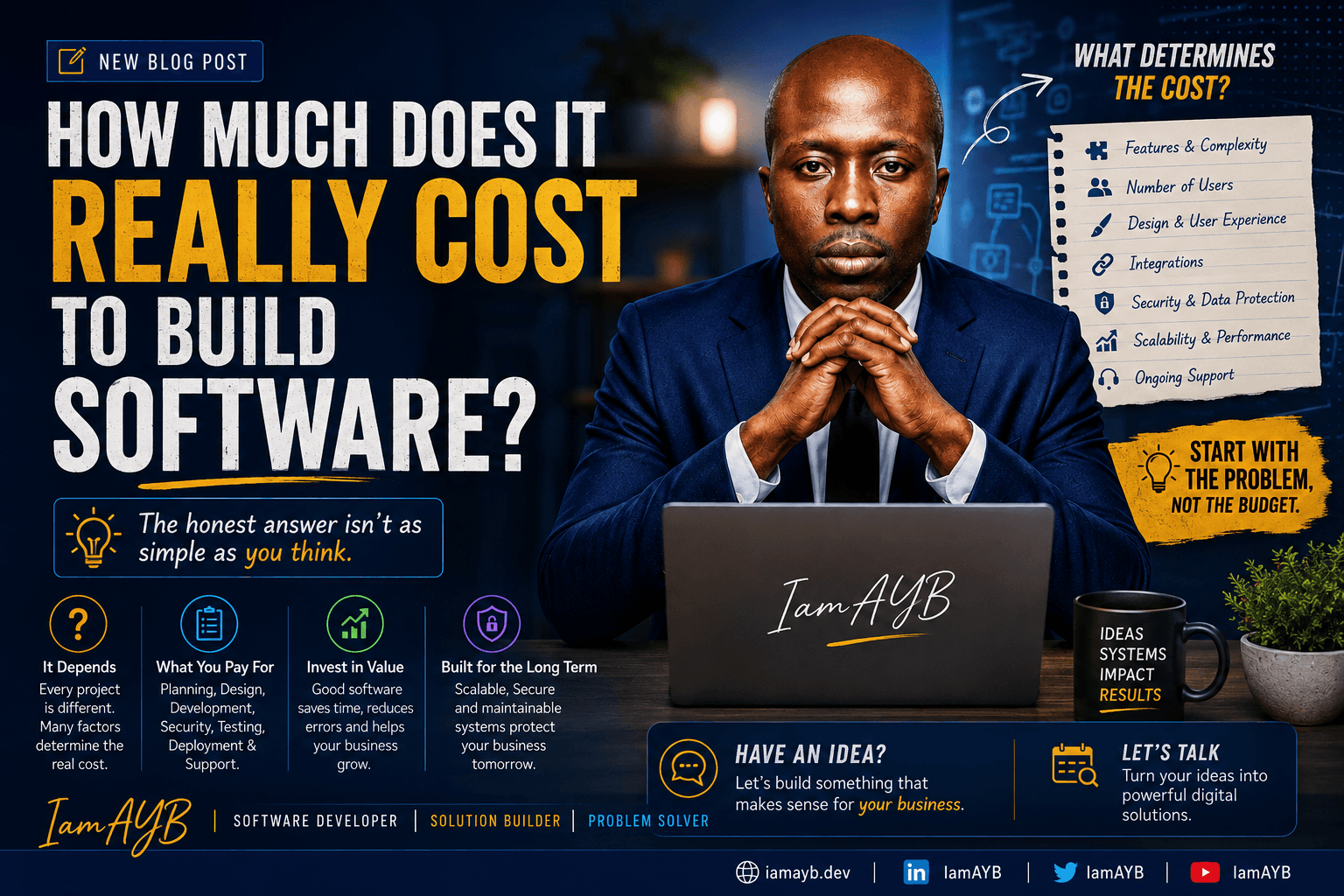
Remember my previous article: How Much Does It Really Cost to Build Software?
I talked about why you shouldn't look at software development as simply:
“How much does an app cost?”
The better question is:
“What will it take to solve this problem properly?”
Starting small can sometimes help answer that question more intelligently.
Instead of spending ₦5 million trying to build everything you can imagine, you might discover that a well-designed first version costing much less can prove whether people actually want the product.
That's not cutting corners.
That's being strategic.
Listen to the People Using It
This is one of my favourite parts of building products.
You can sit down for three months and imagine what people want.
Then you launch.
And your first user says:
“Why did you put this here?”
😂
Another says:
“Can you make this automatic?”
Someone else says:
“We don't actually need this feature.”
And another person says:
“Please add this one thing.”
And suddenly you understand your product much better.
That's why real users matter.
They don't just use your software.
They teach you how to improve it.
Don't Be Afraid to Change Your Idea
This is important for anybody building a startup or SaaS product.
Your original idea isn't sacred.
If you discover that users need something different, change.
If a feature isn't useful, remove it.
If your original process is complicated, simplify it.
If customers are using your product in a way you didn't expect, pay attention.
That's not failure.
That's product development.
I Think Good Developers Should Ask “Why?”
When someone tells me:
“Build this.”
I don't think my job is simply to say:
“Okay.”
Sometimes the better response is:
“Why?”
And sometimes that question saves the client money.
Sometimes it changes the entire project.
Sometimes it makes the project smaller.
Sometimes it makes it bigger.
And sometimes it reveals a completely different solution.
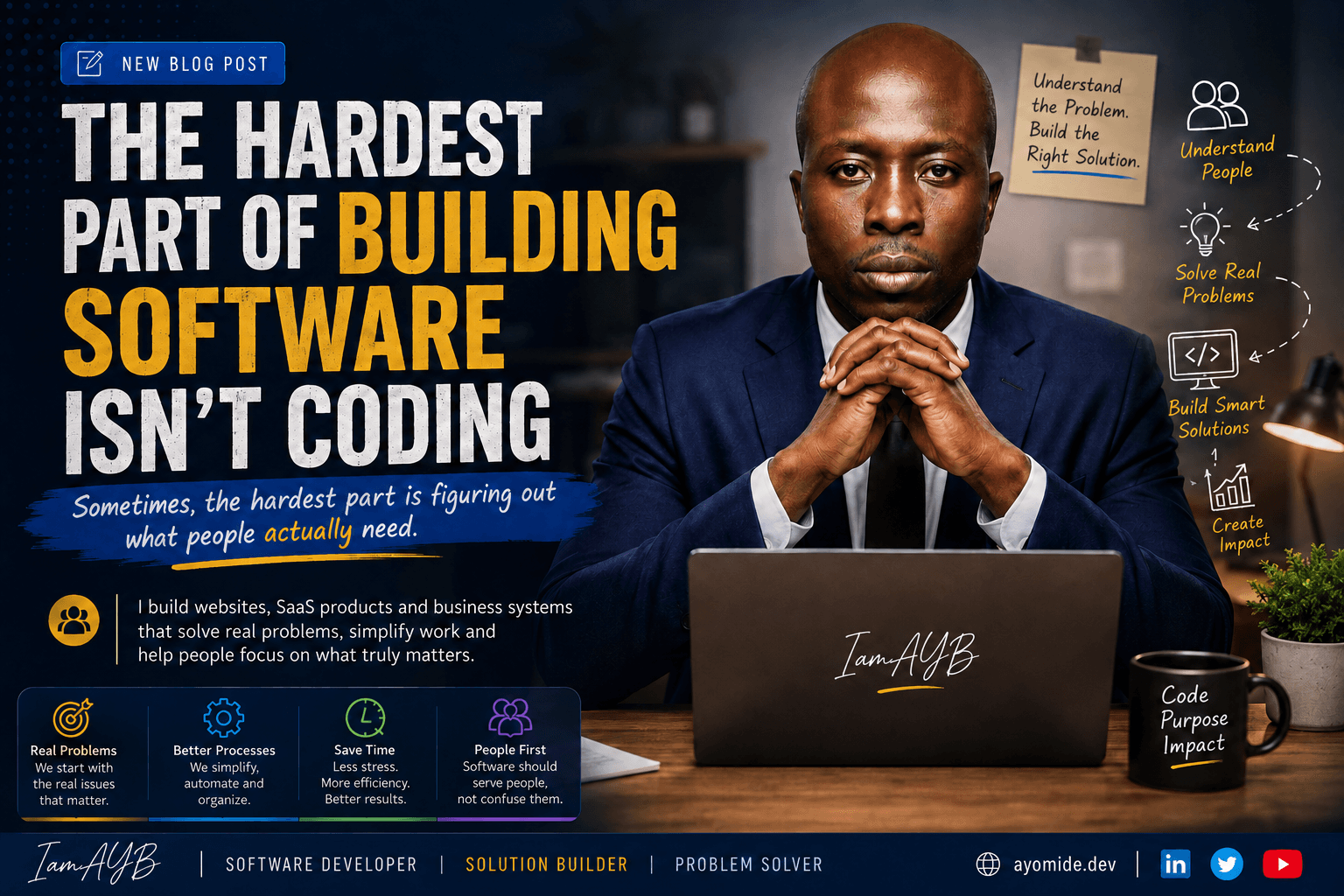
That's why I don't see myself as someone who simply writes code.
I see myself as someone who uses technology to solve problems.
The code is one of the tools.
So, Do You Need an App?
Maybe.
Maybe not.
And that's okay.
You may need:
A website.
A web application.
A mobile application.
A SaaS platform.
An internal business system.
An automation.
An integration.
Or simply a better process.
The important thing is not to fall in love with the technology before understanding the problem.
Start Here Instead
Before you tell a developer:
“I need an app.”
Try saying:
“This is the problem I'm having.”
Then explain it.
Tell them how you're currently handling it.
Tell them what's taking too much time.
Tell them where mistakes happen.
Tell them what your customers complain about.
Tell them what you wish could happen automatically.
That conversation is far more valuable than:
“How much is an app?”
The Best Software Is Sometimes the Software You Don't Notice
Think about that.
When software is really good, it often disappears into the background.
You don't think about the database.
You don't think about the API.
You don't think about authentication.
You don't think about the architecture.
You simply get things done.
You click.
It works.
You move on.
That's the experience I want to create.
Not technology for technology's sake.
But technology that quietly makes people's lives and businesses easier.
My Simple Rule
If I had to reduce everything I've said into one sentence, it would be this:
Don't build an app because you have an idea. Build a solution because you have a problem worth solving.
That's the difference between building software...
and building something people actually need.
So What's Your Problem?
Maybe you're running a school and records are becoming difficult to manage.
Maybe you're running a factory and inventory is getting complicated.
Maybe you're running a cooperative and member records are scattered.
Maybe you have a business idea that currently exists only in your notebook.
Maybe you have an idea for a SaaS product.
Maybe you simply know:
“There has to be a better way to do this.”
That's enough to start.
You don't have to know the technology.
You don't have to know the programming language.
You don't have to know exactly what the application should look like.
Tell me the problem.
Let's figure out the solution.
If you've been following the conversation on this blog, these articles will help you understand this topic even better: How Much Does It Really Cost to Build Software?
Why software doesn't have a one-size-fits-all price—and what you're really paying for.
[Before You Build That App, Answer These 7 Questions]
Don't start with the code. Start by understanding the problem.
These aren't just separate articles.
They're part of the same conversation:
Understand the problem → Define the solution → Build what matters → Create real value.
And that's the way I believe technology should be approached.